
US support for international engagement sees jump in Reagan Foundation poll
The 2025 Reagan Institute Summer Survey showed general support for NATO, surprising numbers when it comes to Ukraine and some unease about acquiring Greenland.
The 2025 Reagan Institute Summer Survey showed general support for NATO, surprising numbers when it comes to Ukraine and some unease about acquiring Greenland.

The Pentagon has made real progress in reaching beyond its historical contractors to “maturing defense startups,” the Ronald Reagan Institute said, but much work is needed.

Explore how software, edge AI and resilient connectivity can strengthen military logistics in contested environments. Join Breaking Defense on Oct. 21 and earn 1 CPE credit.

The Ronald Reagan Institute's Rachel Hoff and Thomas Kenna write in this op-ed that the institute's annual survey shows that "on a bipartisan basis, the American people have a clear preference for internationalism over isolationism."

Meanwhile, the Air Force’s Vice Chief of Staff Gen James Slife said his service has several “compelling programs in the pipeline” but they are “not quite as technologically mature as some of the Army programs.”

“We're still looking for the ability to translate and transition those innovation priorities into capabilities, into programs of record, into budget priorities,” said Rachel Hoff, Reagan Institute’s policy director and one of the authors of a new scorecard evaluating progress in defense innovation.

"There is a reason technology is often called a 'force multiplier' — it’s best when it helps our forces, not when it replaces them," write Rachel Hoff and Reed Kessler of the Reagan Institute.


A decorated combat aviator and biotech CEO advocates preparing for novel viral threats before the next crisis.

A ponderous budget process, overspending on old tech, and chronically late appropriations hamstring the Pentagon’s ability to tap into private-sector innovation, according to the foundation’s new scorecard.

WASHINGTON: A majority of Americans view China has the biggest national security threat to the United States, while trust in the American military continues to erode, according the Reagan Institute’s annual National Defense Survey. The poll found that 52% of Americans see China as a top threat, up from just under 40% in the February […]

Reagan Institute warns of "inadequate" investments, "exceedingly fragile" supply chains, and "insufficient" accountability of government officials, among other US weaknesses.
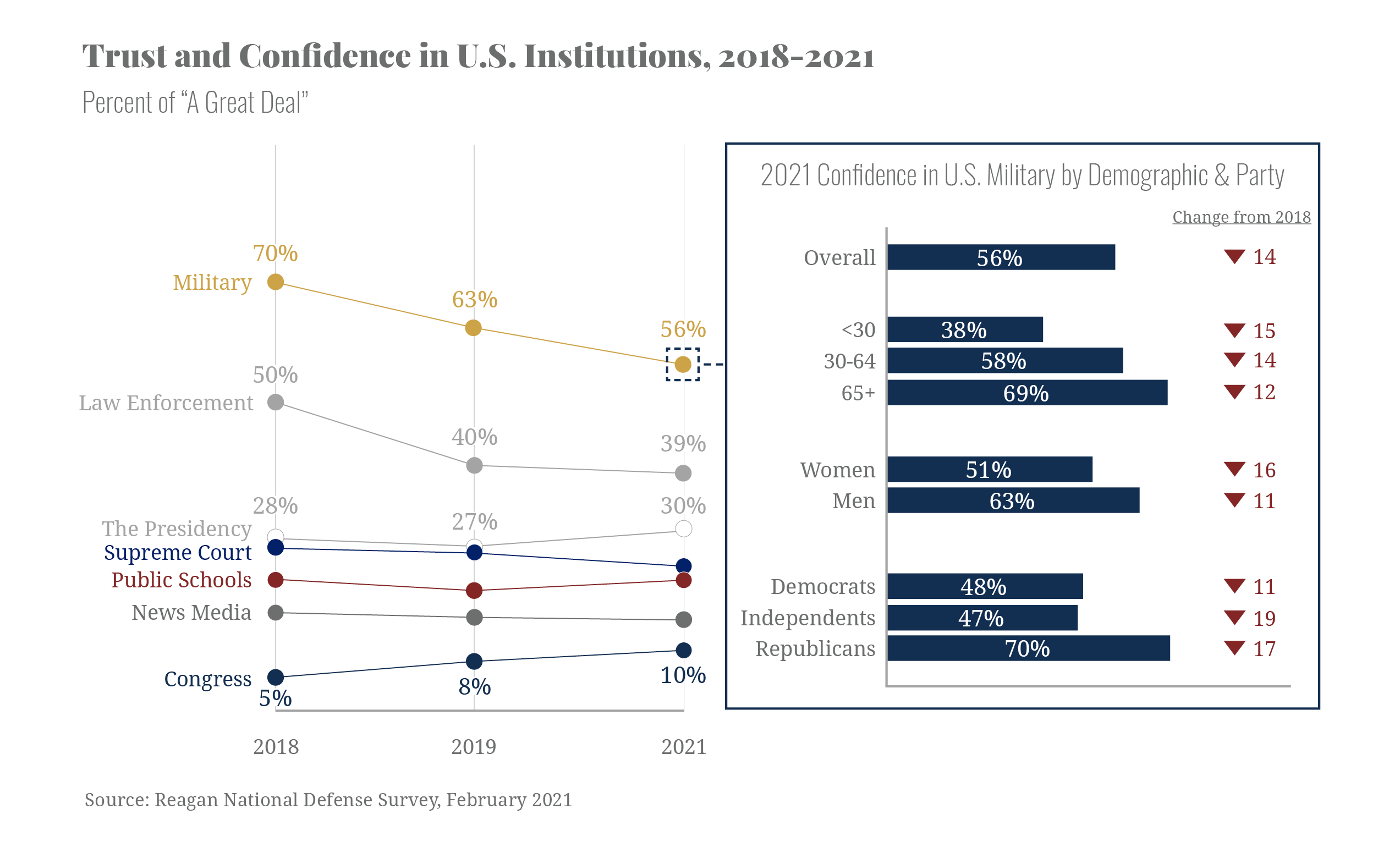
The Reagan Institute’s latest survey reveals confidence in the military has dropped seven percent a year for two years running. But dig deeper, and support for a strong defense remains.


Manufacturing scale, global sustainment, and next-gen tech are becoming inseparable.

Maintaining the US natsec industry's technological edge will require "a more coordinated and collaborative effort among all stakeholders—government, academia, and private sector actors," says former Deputy Defense Secretary Bob Work.